

Are your internal processes a chaotic maze, hindering productivity and draining resources? Do you struggle with disjointed data, making strategic decisions feel like a gamble?
You face the daily challenge of integrating complex operational demands, from financial oversight to supply chain management. Without the right technological backbone, managing a growing enterprise becomes an arduous, error-prone task.
You need to clarify which business software truly addresses your core challenges. This comprehensive guide demystifies Enterprise Resource Planning (ERP) and Customer Relationship Management (CRM), empowering you to make informed decisions.
Understanding Core Business Software Architectures
Modern businesses constantly seek to optimize operations and enhance customer engagement. You often find yourself evaluating sophisticated software solutions designed to streamline workflows and provide critical insights for better decision-making.
Among the most prevalent, and often conflated, categories are Enterprise Resource Planning (ERP) and Customer Relationship Management (CRM) systems. You recognize both as pivotal for business success, yet they serve fundamentally distinct strategic purposes within your organization’s technological ecosystem.
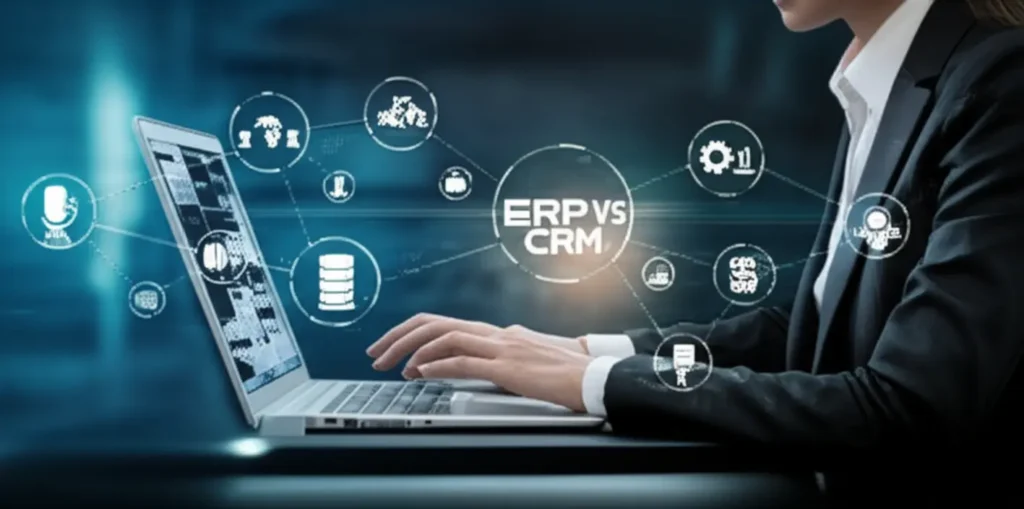
A clear understanding of the core differences when evaluating ERP vs. CRM is paramount for you as a stakeholder. This comprehensive comparative analysis aims to demystify these powerful platforms, providing clear definitions and outlining their primary functionalities.
You need to know that an ERP system integrates your entire suite of core business processes into a unified system. It typically encompasses functions like finance, human resources, manufacturing, supply chain, and project management, ensuring data consistency and operational synergy across departments.
Conversely, CRM solutions laser-focus on managing and analyzing customer interactions and data throughout the customer lifecycle. Their primary objective is to improve your business relationships, assisting in customer acquisition, retention, and driving sales growth effectively.
ERP vs. CRM: Internal Optimization vs. External Engagement
You must understand that an ERP system provides a centralized database that serves as the backbone for all integrated functions. This holistic approach supports a single source of truth, optimizing your resource allocation and improving overall operational efficiency enterprise-wide.
For example, Construtora Ágil in São Paulo implemented an ERP system and saw a 25% reduction in material waste and a 15% acceleration in project delivery times. This allowed them to bid on 10% more projects annually, directly impacting revenue.
CRM systems, however, track customer contact information, preferences, purchase history, and service interactions. A robust CRM empowers your sales, marketing, and customer service teams to deliver personalized experiences and build lasting loyalty.
Consider Loja Encanto Digital, an e-commerce platform in Curitiba. By adopting a comprehensive CRM, they achieved a 20% increase in repeat customer purchases and boosted their average customer lifetime value by 18%, optimizing marketing spend significantly.
While both systems are indispensable business software tools, their operational scope and strategic impact differ significantly. An ERP system primarily optimizes internal operations and resource management, whereas a CRM system externalizes focus towards customer engagement and satisfaction.
Understanding Enterprise Resource Planning (ERP)
You define ERP as Enterprise Resource Planning, a comprehensive business software suite. It manages and integrates your company’s core operational processes by consolidating data from various departments into a single, unified database, offering you a holistic organizational view.
Your primary goal in implementing ERP is to streamline operations, enhance efficiency, and provide a holistic view of your organization. ERP systems aim to break down departmental silos, enabling better decision-making and improved resource planning across your entire enterprise.
Essentially, an ERP system acts as the central nervous system for your business. It automates and integrates critical functions, ranging from financial management and human resources to manufacturing, supply chain management, and project management, giving you unparalleled control.
You gain significant improvements in operational efficiency. Automation of routine tasks reduces manual errors and frees up your employees to focus on more strategic initiatives, leading directly to substantial cost reductions that you can reinvest.
Moreover, with real-time access to integrated data, you, as a leader, can make informed, data-driven decisions more rapidly and confidently. This enhanced visibility is crucial for agile strategic planning and effective responses to dynamic market changes.
Essential ERP Features: Beyond Basic Integration
You need an ERP solution comprising multiple integrated modules, each dedicated to a specific business function. Financial management, for instance, handles the general ledger, accounts payable, accounts receivable, budgeting, and financial reporting, providing you complete fiscal oversight.
Operational modules often include manufacturing for production planning and control, and supply chain management for procurement, inventory, and logistics. These components ensure a smooth flow of materials and products throughout your business lifecycle, reducing bottlenecks.
Human Resources (HR) modules manage payroll, recruitment, employee data, and performance management. Other common modules might cover sales order processing, customer service, quality control, and asset management, tailoring the system to your specific industry needs and pain points, like complex shift scheduling.
Your ERP system also offers inherent scalability, adapting effectively as your business grows and evolves its processes. It helps ensure regulatory compliance by standardizing workflows and maintaining comprehensive audit trails, a vital aspect for many regulated industries.
For instance, Alimentos Saudáveis do Campo, a food distributor, adopted an ERP with advanced inventory and logistics modules. They reduced stockouts by 30% and improved delivery accuracy by 22%, ensuring fresh products reached customers faster and boosting satisfaction.
Data Security and LGPD Compliance in ERP
You recognize that centralizing all your operational data within an ERP system makes data security paramount. Your chosen ERP must include robust security features such as multi-factor authentication, role-based access controls, and end-to-end encryption for all data at rest and in transit.
You are responsible for compliance with the General Data Protection Law (LGPD) in Brazil, or similar global regulations. Your ERP system should facilitate this by providing audit trails, data retention policies, and clear consent management for any personal data it handles, even internally.
Specifically, you need an ERP that enables detailed reporting on data access and modification. This allows you to demonstrate compliance during audits and respond effectively to data subject requests, protecting your company from significant fines and reputational damage.
Metalúrgica Fortes, a manufacturing firm, implemented an ERP with strong security protocols. They avoided a potential LGPD violation by precisely tracking access to employee data and quickly fulfilling a data deletion request, maintaining trustworthiness with their workforce.
Furthermore, you should ensure your ERP vendor provides regular security updates and patches. This proactive approach protects your sensitive financial records, intellectual property, and employee data from evolving cyber threats, guaranteeing business continuity.
What is Customer Relationship Management (CRM)?
You understand Customer Relationship Management (CRM) as a vital business software strategy. It centers on managing and analyzing customer interactions and data across the customer lifecycle, enabling you to build stronger relationships.
Your overarching objective with CRM is to enhance business relationships, thereby improving customer retention and accelerating sales growth for any enterprise. You aim to move beyond simple transactions to lasting partnerships.
CRM systems fundamentally adopt a customer-centric philosophy. They consolidate disparate customer information, collected from various interaction channels, into a single, unified, and accessible database for you and your team.
This consolidated view empowers your business to deeply understand customer behaviors, fostering more personal and effective relationships. You can predict needs and tailor interactions, making customers feel valued.
Ultimately, the strategic deployment of effective CRM business software yields substantial benefits. These include marked improvements in customer retention rates, increased customer lifetime value, optimized operational efficiencies, and enhanced opportunities for cross-selling and up-selling across your customer base.
Core CRM Functions: Driving Sales and Service Excellence
Your CRM platforms are typically structured around three core functional pillars: sales force automation, marketing automation, and customer service automation. These integrated modules streamline the entire customer journey for you.
Within sales, CRM software meticulously tracks leads, manages active opportunities, and generates sales forecasts, offering you a transparent view of the entire sales pipeline. This helps you achieve monthly sales targets more consistently.
For marketing efforts, it facilitates the execution of targeted campaigns, email automation, and precise customer segmentation, optimizing outreach and boosting conversion rates. You launch campaigns knowing your audience is accurately targeted.
Furthermore, CRM significantly elevates your customer service capabilities by centralizing support tickets, tracking interaction history, and often incorporating self-service portals. Service agents gain immediate access to comprehensive customer profiles, ensuring consistent, efficient, and personalized support experiences.
For example, Clínica Vitalis implemented a CRM that integrated with their online scheduling system. They reduced patient waiting times by 15% and increased appointment confirmations by 20%, directly improving patient satisfaction and operational flow.
CRM Data Insights vs. Customer Journey Personalization
A pivotal function of CRM is its robust ability to collect, store, and rigorously analyze vast quantities of customer data. This data transforms into actionable insights regarding market trends and customer preferences, enabling you to make data-driven decisions concerning product development and service enhancements.
By leveraging these insights, you can segment your customer base with high precision, creating highly personalized marketing messages and sales pitches. This tailored approach dramatically increases engagement and conversion rates compared to generic outreach.
Consider Agência Digital Criativa, a marketing agency. By analyzing CRM data, they identified key client behaviors and launched targeted campaigns. This resulted in a 25% higher click-through rate and a 10% increase in new client acquisition for their services.
You can also use CRM data to predict customer churn, allowing you to proactively engage at-risk clients with tailored retention strategies. This not only saves you acquisition costs but also strengthens loyalty and customer lifetime value.
In any comparative analysis, particularly when discussing ERP vs. CRM, you must highlight their distinct focuses. While an Enterprise Resource Planning (ERP) system primarily orchestrates internal operational processes, CRM is singularly dedicated to managing all external customer interactions.
Data Security and LGPD Compliance in CRM
You are handling sensitive customer information within your CRM, so data security is paramount. Your CRM system must safeguard personal data through robust encryption, strict access controls, and regular security audits, protecting your customers’ privacy.
Adhering to LGPD means you must process customer data lawfully, transparently, and only for legitimate purposes. Your CRM should provide features to manage consent, facilitate data access requests, and ensure data portability, putting customers in control.
You need to document your data processing activities within the CRM, including how data is collected, stored, and used. This documentation is crucial for demonstrating compliance to regulatory bodies and building trust with your customer base.
Soluções Financeiras Pró-Crédito, a financial services provider, utilized their CRM’s LGPD compliance features to manage customer consent for marketing communications. This proactive approach helped them avoid fines and build a reputation for trustworthiness, increasing client confidence by 12%.
Furthermore, your CRM should offer reliable data backup and disaster recovery mechanisms. This ensures business continuity and protects your invaluable customer data from loss, maintaining your ability to serve clients even in unforeseen circumstances.
Distinguishing Core Business Systems
The debate of ERP vs. CRM is fundamental for understanding modern business software. You recognize both as critical enterprise applications, yet they serve distinctly different purposes. This foundational comparative analysis will clarify their individual definitions and operational scopes, aiding you in strategic decision-making and optimal resource allocation.
An ERP system represents a comprehensive suite of business software. It integrates your organization’s core processes into a single system. These processes typically include finance, human resources, manufacturing, supply chain, and procurement, streamlining your internal workflow.
Your ERP’s primary objective is to optimize resource utilization and operational efficiency across departments. By providing a centralized database, ERP ensures data consistency and real-time insights, essential for your informed decision-making and comprehensive reporting.
Conversely, CRM is a different category of business software. It focuses exclusively on managing your organization’s interactions with current and potential customers. CRM systems consolidate customer data, sales pipelines, marketing campaigns, and service interactions effectively, empowering your front-line teams.
Your main goal with CRM is to improve customer relationships, enhance customer satisfaction, and drive sales growth. It manages the entire customer lifecycle, from initial contact to post-sale support, fostering stronger client loyalty and maximizing customer lifetime value for sustained growth.
Functional Differences: Internal Operations vs. Customer Interactions
You find the core distinction in ERP vs. CRM lies in their operational focus. ERP systems are internally oriented, optimizing back-office functions and resource management. They handle the “how” of business operations, ensuring smooth internal processes and compliance across the board.
Conversely, CRM systems are externally focused, managing front-office interactions. They address the “who” and “why” of customer engagement, concentrating on sales, marketing, and customer service activities. This external perspective directly drives your revenue and builds client relationships.
From a data perspective, an ERP system centralizes operational data like financial records, inventory levels, and production schedules. Its strategic objective is cost reduction, efficiency gains, and accurate financial reporting, providing you a single source of truth for internal metrics.
A CRM system, however, centralizes customer-centric data, including contact information, purchase history, and communication logs. Its strategic objective is revenue growth, customer retention, and improved customer satisfaction. It helps you segment customers and personalize interactions effectively.
You often find that both systems, while distinct, are increasingly integrated to provide a holistic view of your business. An integrated solution allows for seamless data flow between internal operations and customer interactions, for instance, enabling sales teams to access inventory data directly.
The Power of Integration: ERP and CRM in Synergy
While often discussed in terms of ERP vs. CRM, you recognize these distinct business software solutions are not competitors. They are powerful allies. An effective comparative analysis reveals their complementary nature, driving comprehensive organizational efficiency for you.
You understand that ERP systems primarily manage back-office functions like finance, inventory, and supply chain. Conversely, CRM focuses on front-office interactions, including sales, marketing, and customer service, optimizing different facets of your company.
Understanding these fundamental definitions highlights how their integration creates a more robust, holistic business system for you. They manage different facets of a company yet thrive when working in tandem, optimizing various operational touchpoints.
A key benefit you gain from integrating ERP and CRM is seamless data synchronization. Customer information, order history from CRM, and product availability from ERP converge into a single, unified database, eliminating fragmented data sources and ensuring consistency across departments.
Consequently, your sales teams gain real-time visibility into inventory levels and order fulfillment statuses. Furthermore, financial departments can access accurate sales data instantly, streamlining invoicing and reporting. This integrated approach underpins more informed decision-making across your enterprise.
Enhanced Operational Efficiency: Bridging Front and Back Office
You achieve significant operational efficiency by integrating these business systems. A sales order initiated in the CRM can automatically trigger inventory checks and production orders within the ERP. This automation reduces manual data entry and minimizes errors, saving you valuable time.
Moreover, streamlined workflows accelerate your entire order-to-cash cycle. From initial customer contact to product delivery and payment processing, each step becomes more fluid and responsive. This operational synergy translates directly into improved productivity and resource utilization, maximizing your investments.
Consider Transportadora Rápida, which integrated its CRM with its ERP. They reduced order processing time by 20% and improved delivery schedule adherence by 18%, leading to a 10% increase in customer satisfaction for logistical services.
With synchronized data, your customer service representatives using CRM have complete insights into a customer’s purchasing history and current order status via ERP. This comprehensive view allows for personalized and proactive support, addressing critical pain points like delivery delays before they escalate.
Ultimately, this unified understanding of the customer journey leads to a superior customer experience. Faster resolutions, informed interactions, and consistent service build stronger relationships and foster greater customer loyalty, giving you a critical advantage in competitive markets.
Market Data & ROI: Quantifying Integration Value
You recognize that market data consistently supports the value of integrated systems. Studies indicate that companies integrating ERP and CRM experience an average 25% reduction in administrative costs and a 15% increase in customer retention, directly impacting your bottom line.
Let’s calculate the potential ROI for your business. Imagine your company, TechSolutions Ltda., spends $100,000 annually on administrative tasks. An integrated system could save you 25%, equating to $25,000 in annual savings. If your initial investment is $75,000, your ROI in the first year alone is ($25,000 / $75,000) * 100% = 33.3%.
Beyond cost savings, you also benefit from revenue growth. If your current annual revenue is $5,000,000 and customer retention increases by 15%, assuming a 10% profit margin on retained customers, you gain an additional $75,000 in profit. This demonstrates the tangible financial impact.
The combined insights from integrated ERP and CRM platforms offer you a panoramic view of business performance. Financial metrics from the ERP merge with customer behavior and sales trends from the CRM, providing unparalleled data for strategic analysis and growth projections.
Consequently, you, as a business leader, can make more data-driven decisions, from sales forecasting to product development and market strategy. This comprehensive understanding of both internal operations and external customer interactions fuels sustainable growth and competitive advantage for your organization.
Choosing the Right Solution: A Step-by-Step Guide
You need to adopt new business software with careful consideration, moving beyond a simple ERP vs. CRM debate. You must first analyze your primary operational challenges and strategic goals. Is your aim to streamline internal processes, or to enhance external customer interactions?
A clear understanding of the definitions for each system is crucial. ERP systems primarily integrate and manage core business processes like finance, human resources, and supply chain. Conversely, CRM solutions focus on managing all interactions with current and potential customers to improve business relationships.
If your goal is to achieve greater operational efficiency, an ERP system is likely paramount. It centralizes data, eliminating silos across departments, from manufacturing to accounting. This integration provides a holistic view of your business, enabling better resource allocation and decision-making.
Conversely, if improving customer satisfaction, sales performance, and marketing efforts is your priority, a CRM system is indispensable. It tracks customer data, manages leads, and automates communication, ensuring personalized experiences. This fosters stronger customer relationships and drives revenue growth.
Often, a comparative analysis reveals that both systems offer distinct benefits. Many businesses find immense value in integrating ERP and CRM. This synergy allows sales and customer service teams to access critical product availability or order status data, bridging the gap between front- and back-office functions.
Implementation and Ongoing Support: Ensuring Success
You must consider the long-term viability of your business software. The chosen system must be scalable, capable of adapting to future growth and evolving business requirements. Evaluating vendor roadmaps and the flexibility of the architecture ensures your investment remains relevant as your company expands.
Effective data management underpins both ERP and CRM success. You must assess how easily data can be accessed, analyzed, and secured within each system. Furthermore, contemplate how the software facilitates communication channels, such as integrating with platforms for multi-user WhatsApp, ensuring seamless customer interactions.
Even the most advanced business software fails without proper user adoption. Therefore, you must consider the system’s user-friendliness and the availability of training resources. A smooth transition and effective training programs are vital to ensure your employees embrace the new technology, maximizing your ERP vs. CRM investment.
The importance of support cannot be overstated. You need a vendor who offers robust technical and customer support, including clear Service Level Agreements (SLAs). This ensures that when issues arise, you receive prompt and effective assistance, minimizing downtime and operational disruptions.
Finally, a thorough evaluation of the potential Return on Investment (ROI) is paramount. This involves not only the upfront costs but also implementation time, ongoing maintenance, and the expected gains in efficiency, sales, and customer loyalty. A clear financial projection guides your strategic decision-making in selecting the optimal business software.
Conclusion: Empowering Your Business with the Right Technology
Understanding the fundamental distinctions in the ERP vs. CRM debate is crucial for your organization. You seek operational excellence and customer satisfaction, and while both are powerful business software solutions, their primary objectives and scopes differ significantly.
An Enterprise Resource Planning (ERP) system primarily streamlines your internal operations. Its focus is on integrating core business processes like finance, human resources, manufacturing, and supply chain management. This deep integration provides you a unified view of your organization’s internal health, optimizing resource allocation and enhancing efficiency.
Conversely, a Customer Relationship Management (CRM) system centers entirely on external interactions. It manages all aspects of customer relationships, from initial lead generation and sales opportunities to customer service and marketing campaigns, helping you drive revenue.
The definitions clearly show their divergent paths: ERP looks inward to optimize resources, while CRM looks outward to optimize customer engagement. Consequently, choosing between them is often a false dichotomy. Your real strategic advantage frequently lies in understanding how these systems can work together harmoniously.
A truly empowered business leverages both ERP and CRM to achieve comprehensive growth. When integrated, these business software solutions create a powerful ecosystem. For instance, sales data from CRM can flow into ERP for accurate forecasting, while inventory levels from ERP can inform CRM for better order fulfillment communication.
This comparative analysis reveals that ERP ensures the efficiency of back-office functions, delivering products and services reliably. Meanwhile, CRM ensures the effectiveness of front-office functions, building lasting relationships and driving revenue. Together, they offer you a 360-degree view of both internal operations and external customer interactions.
For you, as Business Leaders and IT Directors, the decision is less about “either/or” and more about strategic implementation. Identifying specific business needs, pain points, and growth objectives should guide your choice and integration strategy. A phased approach can often be beneficial, starting where the most immediate impact is needed.
Investing in the right business software is not merely about adopting technology; it’s about strategically equipping your enterprise to thrive in a complex, competitive market. You manage both resources and relationships effectively, securing your position for long-term success and continuous improvement.